1. Introduction
Linear codes are essential tools in coding theory, with vast applications in error correction, communication systems, and cryptography. A linear code is typically denoted by [n, k, d] with n being the length, k indicates the dimension, and d denotes the minimum Hamming distance. These codes also play a crucial role in post-quantum cryptography systems, such as McEliece cryptosystem.
A closely related concept is linear code equivalence which states that two codes say A and B, can be considered equivalent if and only if A can be transformed by permuting coordinate positions or with operations such as column scaling. Linear code equivalence computation gained recognition in literature as it aids multiple representations of a code while maintaining properties, it is also useful in code classification and cryptanalysis
| [1] | N. Sendrier, “Finding the permutation between equivalent linear codes: the support splitting algorithm,” IEEE Trans. Inf. Theory, pp. 1193–1203, 2000,
https://doi.org/10.1109/18.850662 |
[1]
.
Tanner graph can be described as a bipartite graph to represent parity check matrix in graphical form. The graph uses variable nodes corresponding to codewords bits and check node corresponds to parity check constraint, also in this graphical representation, an edge is created between variable node and check node if and only if the bit participates in parity check equation
| [2] | R. M. Tanner, “A Recursive Approach to Low Complexity Codes,” IEEE Trans. Inf. Theory, no. 5, 1981. |
[2]
. Tanner graph was mainly used to aid decoding algorithms and was used for message transmission concepts such as belief propagation (BP) algorithm. Tanner graph was proposed originally to construct long codes from smaller ones, but later
| [3] | T. J. Richardson and R. L. Urbanke, “Efficient encoding of low-density parity-check codes,” IEEE Trans. Inf. Theory, vol. 47, no. 2, pp. 638–656, 2001,
https://doi.org/10.1109/18.910579 |
[3]
used the concept as a foundation to Low Density Parity Check Code (LDPC).
BP algorithm can efficiently decode Low Density Parity Check Code (LDPC) by passing messages along the edges of Tanner graph. In definition, LDPC are represented by sparse parity-check matrices and are further represented using Tanner graph (TG) in order to aid Shanon-limit performance with manageable performance complexity
| [5] | V. Ninkovic, O. Kundacina, D. Vukobratovic, C. Häger, and A. G. i Amat, “Decoding Quantum LDPC Codes Using Graph Neural Networks,” Aug. 2024, Accessed: Feb. 27, 2025. Available: http://arxiv.org/abs/2408.05170 |
[5]
.
It is crucial to note that researchers use summarized representations i.e. generator and parity-check matrices that define the code. To the best of our knowledge, existing graph-based methodologies representing linear codes primarily focus on parity constraints and each codeword is not explicitly model as a node within the graph structure. This limitation restricts their applicability in tasks that require a complete structural view of the code, such as equivalence testing and learning-based analysis.
Graphical representations of linear codes have a rich history. With decoding as a yardstick, Tanner (1981) proposed the use of bipartite graphs to represent linear block codes using their parity-check matrices. The researcher opined that the graphical representation would provide a visual mapping of the bits which participate in each parity check.
The framework proposed by
| [2] | R. M. Tanner, “A Recursive Approach to Low Complexity Codes,” IEEE Trans. Inf. Theory, no. 5, 1981. |
[2]
has been the foundation of LDPC codes as noted by
| [3] | T. J. Richardson and R. L. Urbanke, “Efficient encoding of low-density parity-check codes,” IEEE Trans. Inf. Theory, vol. 47, no. 2, pp. 638–656, 2001,
https://doi.org/10.1109/18.910579 |
[3]
and others. Variants of Tanner graphs and related graphical models have been applied to decoding, code construction, and code analysis. As a result of the proposition of various graph models, important properties such as girth, cycles which impact decoder performance are made available. Despite the prevalence of the Tanner graph for decoding, little literature exists on graphical representations that capture all codewords of a code.
While Tanner graphs and related representations have been widely used for decoding and constraint-based analysis, they do not provide a complete representation of the codeword space. In particular, the absence of explicit codeword-level representation limits their effectiveness in problems where global structural properties are essential. This motivates the need for a representation that captures the full set of codewords within a unified graphical framework.
To address this limitation, we introduce a novel bipartite graph representation of binary linear codes in which one partition corresponds to bit positions and the other corresponds to individual codewords. Unlike traditional representations, the proposed approach explicitly encodes the full codeword set, enabling complete structural characterization. Furthermore, we establish that this representation is information-complete and that linear code equivalence under coordinate permutation corresponds directly to graph isomorphism under the proposed construction.
1.1. Linear Codes and Tanner Graphs
Traditionally, the representation of linear codes is done algebraically. Linear code can be represented using Generator matrix G (k × n) that spans the code or by parity-check matrix H ((n − k) × n) that depicts code’s constraints.
Tanner proposed a graphical measure to represent the parity-check structure of linear codes. In the graph representation, each check node enforces a parity-check equation and connect variable nodes (bits) that participate in the equation
| [2] | R. M. Tanner, “A Recursive Approach to Low Complexity Codes,” IEEE Trans. Inf. Theory, no. 5, 1981. |
[2]
.
Tanner graph became notable with LDPC codes where it is sparse, LDPC codes have relatively low average node degree and this is a crucial factor for the success of iterative decoders
| [4] | H. Dehghani, M. Ahmadi, S. Alikhani, and R. Hasni, “Calculation of Girth of Tanner Graph in LDPC Codes,” Trends Appl. Sci. Res., vol. 7, no. 11, pp. 929–934, Nov. 2012,
https://doi.org/10.3923/TASR.2012.929.934 |
[4]
. In the case where parity-check matrices are dense, its Tanner graph representation will equally have high degree nodes.
It is important to note that dense nodes are less useful for iterative decoding, this fact suggests why LDPC codes have received much attention in communication system. Outside LDPC and related sparse codes, Tanner graphs have not been leveraged in traditional coding theory analysis.
Research has leverage graph based representational for other purposes; for example graph model of codes has been used in graph neural network decoder, in this instance a neural network was trained on a Tanner graph to decode errors
| [5] | V. Ninkovic, O. Kundacina, D. Vukobratovic, C. Häger, and A. G. i Amat, “Decoding Quantum LDPC Codes Using Graph Neural Networks,” Aug. 2024, Accessed: Feb. 27, 2025. Available: http://arxiv.org/abs/2408.05170 |
[5]
.
| [5] | V. Ninkovic, O. Kundacina, D. Vukobratovic, C. Häger, and A. G. i Amat, “Decoding Quantum LDPC Codes Using Graph Neural Networks,” Aug. 2024, Accessed: Feb. 27, 2025. Available: http://arxiv.org/abs/2408.05170 |
[5]
demonstrated that dense code graphs can be processed using machine learning algorithms, the only limitation to this revelation is that limited work exist on constructing graphs for any linear code.
1.2. Graph-based Representation of Codes
The ability to carry out decoding on Tanner graph stems from the local nature of check constraints in the parity check. If a linear code TG is cycle-free, the maximum-likelihood decoding can be done in
O(
n2) time using dynamic programming
| [6] | T. Etzion, A. Trachtenberg, and A. Vardy, “Which Codes Have Cycle-Free Tanner Graphs?,” IEEE Trans. Inf. Theory, vol. 45, no. 6, p. 2173, 1999. https://doi.org/10.1109/18.782130 |
[6]
. Literature on coding theory has largely centered on algebraic invariants rather than graphical interpretation of general codes
| [7] | F. J.. MacWilliams and N. J. A.. Sloane, “The theory of error-correcting codes,” p. 762, 20061977, 1977. |
[7]
.
TG bridged this knowledge gap for specific families i.e. LDPC and Turbo codes where the researcher indicated that these codes can in principle be represented as a graph using its parity check matrix. Parity check matrix for a (
n,k,d) code can be graphically represented using a
n×(
n−
k) bipartite graph where
n columns correspond to bit nodes while
n −
k row correspond to check nodes
.
Another major evolution of Tanner graph is the expander codes which are constructed from bipartite expander graphs, in this case the graph structure directly influences code properties. It is crucial to note that expander graphs are sparse (a feature indicating prominence in decoding) but highly connected and has wide application in different areas including complexity theory, coding theory, algorithm design, cryptography, etc.
To the best of our knowledge, existing graphically representation of linear codes do not explicitly model all codewords within a unified bipartite structure and this can be attributed to the fact that most linear codes do not naturally have low density and hence will have a dense parity-check matrix (
H) which will in turn not encourage its conversion to graph. Linear code without low density
H would have
O(
n2) edges. This worst-case quadratic complexity is not a fundamental barrier as graphs with thousands of nodes can have millions of edges which are still manageable for computer algorithms
.
1.3. Trellis Representations and Trellis-based Decoding
Other than Tanner graph, linear code can be represented by trellises-time-index graphical models. These graphs depict how codewords evolve through states. A trellis diagram is basically a state machine unrolling of a code: each path through trellis corresponds to a codeword.
Trellis diagrams have been used to represent convolutional codes, and some types of block code due to its ability to aid maximum-likelihood decoding via Viterbi algorithm. It is worth noting that only linear block code can be represented using a trellis diagram however its complexity is not always manageable.
States in trellis encapsulate past input history or parity context and are indicated as nodes at each time step in the diagram, also edges represent transitions labelled by bits. For optimal decoding of short codes or convolutional codes, trellis representation can be leveraged on. The Viterbi algorithm operates on trellis to find the codeword path with maximum likelihood.
In recent years, trellis representation was applied to Polar codes and related constructions. Polar codes are mainly decoded by successive cancellations. However, in
study, the researcher merges convolutional precoding with polar coding, and this led to the creation of trellis representation of convolutional code preceding the polar transform.
The result of
’s research is a concatenated code that is decodable using a sequential algorithm operating on a combined trellis/tree structure. PAC codes were reported to dramatically improve the finite-length performance of polar codes.
study is a striking example of how adding trellis-based component to a code can yield gains.
Summarily, trellis diagram offers a graph-based view in the time dimension and are essential tool for optimal decoding of certain codes via Viterbi. Recent literature like PAC codes do suggest that trellises are still relevant.
1.4. Small Dimension Binary Codes in Cryptography and Machine Learning
In research conducted by
| [11] | A. Aliouat and E. Dupraz, “Goal-Oriented Source Coding using LDPC Codes for Compressed-Domain Image Classification,” Mar. 2025, Accessed: May 12, 2025. Available:
https://arxiv.org/abs/2503.11954v1 |
[11]
, the researchers proposed the use of LDPC codes as compressed domain encoding for images, the researchers further revealed that neural network is able to classify images from LDPC encoded data with smaller models and higher accuracy than with arithmetic coding.
Also, recent literature revealed that structured binary codes including LDPC codes is able to encode information in ways that deep learning models can exploit effectively and hence yielding efficient models for classification task
| [11] | A. Aliouat and E. Dupraz, “Goal-Oriented Source Coding using LDPC Codes for Compressed-Domain Image Classification,” Mar. 2025, Accessed: May 12, 2025. Available:
https://arxiv.org/abs/2503.11954v1 |
| [12] | A. Thomas et al., “Streaming Encoding Algorithms for Scalable Hyperdimensional Computing,” Sep. 2022, Accessed: May 12, 2025. Available: http://arxiv.org/abs/2209.09868 |
[11, 12]
.
In all the highlighted cases, the dimensions of referenced codes are kept modest to enable full code analysis while the length can be large without fundamentally harming these applications.
Recent studies have opined that when full codeword enumeration or complete analysis is the goal, the complexity grows mainly with 2
k (number of codewords) and not with n i.e. length, also exhaustive search over all codewords becomes feasible only if k is small
| [13] | N. Raviv, “Linear Codes for Hyperdimensional Computing,” Mar. 2024, Accessed: May 12, 2025. Available:
https://arxiv.org/abs/2403.03278v1 |
| [14] | M. Grassl, "Computing Extensions of Linear Codes," 2007 IEEE International Symposium on Information Theory (ISIT 2007), Nice, France, 2007, pp. 476-480.
https://doi.org/10.48550/arXiv.0704.2596 |
[13, 14]
.
Summarily, increasing length n solely does not create an exponential bottleneck, only dimension k drives complexity. As a result of this many recent studies exploit very long codes (large n) with moderate k, since this approach enables structural code analysis to be done exhaustively while benefiting from long code properties like high distance.
In a study by
| [15] | L. E. Danielsen and M. G. Parker, “Edge Local Complementation and Equivalence of Binary Linear Codes,” Des. Codes Cryptogr., vol. 49, no. 1–3, pp. 161–170, Oct. 2007,
https://doi.org/10.1007/s10623-008-9190-x |
[15]
, exhaustive classification of all binary length 14 was achieved using graph-based equivalence method. Such results are possible because in those cases dimension k is small enough to enumerate all codewords for each code, this further confirms that small k linear codes are well suited to tasks like structural code analysis, visualization, and machine learning
| [11] | A. Aliouat and E. Dupraz, “Goal-Oriented Source Coding using LDPC Codes for Compressed-Domain Image Classification,” Mar. 2025, Accessed: May 12, 2025. Available:
https://arxiv.org/abs/2503.11954v1 |
| [13] | N. Raviv, “Linear Codes for Hyperdimensional Computing,” Mar. 2024, Accessed: May 12, 2025. Available:
https://arxiv.org/abs/2403.03278v1 |
| [14] | M. Grassl, "Computing Extensions of Linear Codes," 2007 IEEE International Symposium on Information Theory (ISIT 2007), Nice, France, 2007, pp. 476-480.
https://doi.org/10.48550/arXiv.0704.2596 |
[11, 13, 14]
.
It is critical to indicate that the exponential dependence on the dimension (k) is inherent to any scheme that requires explicit enumeration of all codewords. In practice, many applications in code analysis, classification, and machine learning focus on moderate values of (k), where full enumeration remains computationally feasible. This aligns with existing studies that exploit small-dimensional codes for exhaustive structural analysis.
3. Results and Discussions
In this section, We provide the algorithm to represent linear code in bipartite graphical form. Next, we illustrate the algorithm with examples, showing the Tanner graph for different codes and discussing their structural features.
3.1. Proposed Algorithm
Algorithm 1: Linear Code to Bipartite Graph Conversion
Require:
, a binary linear code
Ensure:
G = (U ∪ V, E), a bipartite graph representation of C
1. U ← {p₁, p₂,..., pn} (position nodes)
2. V ← {w₁, w₂,..., w_|C|} (codeword nodes)
3. E ← ∅
4. For j = 1 to |C| do
5. Let
6. For i = 1 to n do
7. If = 1 then
8. Add edge (pᵢ, wj) to E
9. End If
10. End For
11. End For
12. Return G = (U ∪ V, E)
3.2. Runtime Behavior of the Proposed Algorithm
To evaluate the practical feasibility of the proposed scheme, Runtime analysis was conducted using linear codes with different parameters [n,k,d]. This was done to observe how the runtime changes as a function of:
Code length (n)
Code dimension (k): this determines the total number of codewords |C| = 2k.
3.2.1. Setup and Measurement
Using a mid-range workstation (AMD Intel i7 processor with 16 GB RAM), the algorithm was implemented using Python programming language. Standard timing utilities were included in the implementation such that average time-taken to construct graphical representations of the linear codes are recorded.
Table 1. Observed runtime on different parameter [n,k].
Code Dimension k | Code Length n | Codewords 2k | Edges | Average Runtime(ms) |
4 | 10 | 16 | 80 | 2 |
6 | 20 | 64 | 512 | 5 |
8 | 30 | 256 | 2,880 | 18 |
10 | 50 | 1,024 | 20,480 | 55 |
12 | 50 | 4,096 | 204,800 | 210 |
14 | 50 | 16,384 | 819,200 | 960 |
To establish runtime growth rate, the proposed algorithm was evaluated using increasing linear code dimensions whiles maintaining moderate code lengths. Recorded results consistently indicate a predictable exponential growth both in edge count and runtime, this behaviour further confirms the theoretical complexity However, despite this growth rate, the implementation remains efficient for moderate dimensions, and hence supporting its applicability in practical scenarios involving structural code analysis.
3.2.2. Observations
Linear growth of the runtime is observed in relation to the length n, this is consistent with the algorithm’s time complexity of O(n · 2k).
In terms of the dimension k, exponential growth of runtime is observed i.e increment in dimension k doubles the number of codewords as well as significant increase in the number of graph edge.
Beyond runtime performance, it is important to examine the structural growth of the resulting graph. The number of nodes in the proposed representation grows as (n + 2^k), while the number of edges grows as This reflects the explicit representation of all codewords, which distinguishes the proposed method from traditional parity-check-based graphs that scale primarily with (n) and (n-k).
This structural expansion is not a limitation but a direct consequence of explicitly representing the full codeword space. Consequently, the representation is particularly suitable for applications such as code equivalence testing and graph-based learning, where full structural information is required.
3.2.3. Practical Implication
The results affirm the efficiency of the algorithm; it can be established that increasing the length n of linear codes does not lead to performance bottleneck. Furthermore, the results obtained suggest completeness of the algorithm and therefore uphold its application in code structure analysis, visualization, and machine learning where completeness is more critical than real time speed.
3.3. Theoretical Properties of the Proposed Representation
The proposed algorithm is not only a visualization tool but also possesses essential theoretical properties. In particular, it is information-complete and preserves equivalence structure, as formalized below.
3.3.1. Theorem 1: Information-completeness of the Representation
Let be a binary linear code and let be the bipartite graph constructed using the proposed algorithm, where represents bit-position nodes and represents codeword nodes.
Then, the graph uniquely determines the code . That is, there exists a one-to-one correspondence between and .
Proof
Let , where , and let the corresponding bipartite graph be ,
with:
Define the edge set:
For each , define its neighborhood:
By construction, we have:
which implies that the neighborhood uniquely determines the support of the codeword , i.e.,
Therefore, each codeword can be uniquely reconstructed from the adjacency structure of .
Define the mapping:
From the construction, is well-defined and injective, since distinct nodes correspond to distinct neighborhoods and hence distinct codewords.
Moreover, is surjective by definition of , as every codeword in is represented by some node in .
Hence, is bijective.
Consequently, the graph encodes all information necessary to reconstruct , and the mapping between and is one-to-one.
3.3.2. Theorem 2: Code Equivalence and Graph Isomorphism
Let be binary linear codes, and let
be their corresponding bipartite graph representations.
Then:
where equivalence is under coordinate permutation and graph isomorphism preserves the bipartition.
Proof
Let
Their graph representations are defined as
where
() Suppose .
Then there exists a permutation such that
Define
where .
If , then , hence , implying
Thus, preserves adjacency and is an isomorphism.
() Suppose . Then there exists a bijection preserving adjacency and bipartition, inducing a permutation such that
For any , let .
Then adjacency preservation implies
so
Hence,
and therefore .
3.4. Illustrative Example of Graph Construction
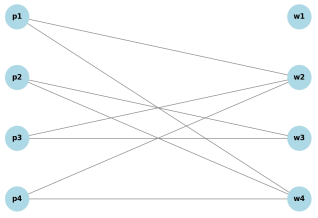
To demonstrate the proposed algorithm, it is applied to a simple linear code with parameters (4,2).
C = {0000, 1011, 0110, 1101}
The above code has length n = 4, dimension k = 2, and contains 2k = 4 codewords.
Using the proposed algorithm, a bipartite graph is generated with:
4 bit-position nodes: p1, p2, p3, p4
4 codeword nodes: w1, w2, w3, w4
Edges representing 1s in each codeword at corresponding bit positions.
The output graph is thus
Figure 1. Each of the edge in the graph connects a codeword node to the position node if and only if it has a value of 1. For instance, the second codeword 1011 (i.e
w2) is connected to positions
p1,
p3, and
p4, reflecting the 1s in the first, third, and fourth positions of the codeword.
Figure 1. Bipartite graph constructed from the codewords {0000, 1011, 0110, 1101}.
Left nodes are the bit positions (p1 to p4) while the right nodes are the codewords (w1 to w4) in the linear code. Edges reflect occurrence of 1 in codeword-bit position pairs.
The proposed algorithm is able to generate graphical representation of the linear code in this instance in approximately 0.11 milliseconds, this further confirms its efficiency even at small scales. This illustration validates that the algorithm correctly convert the linear code into an interpretable bipartite graph form, providing a solid foundation for further analysis such as equivalence testing and graph-based learning.
3.5. Illustrative Example of Bipartite Graph Construction (Complex Case)
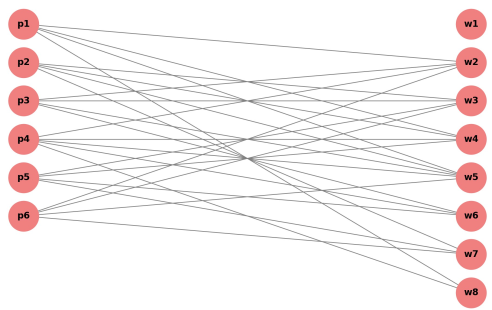
To measure the efficiency of the proposed algorithm, it is applied to a linear code with higher length and dimension. In this instance a linear code with parameters (6,3) is used.
C = {000000, 101101, 011011, 110110, 111101, 001110, 010011, 100100}
This code has length n = 6, dimension k = 3, and contains 2k = 8 codewords. Using the algorithm described in Section 6.3, a bipartite graph was constructed with:
6 bit-position nodes: p1, p2, p3, p4, p5, p6
8 codeword nodes: w1 to w8
Edges representing 1s in each codeword at the corresponding bit positions.
The resulting graph is shown in
Figure 2. Each edge connects a codeword node to the bit positions where it has a value of 1. For example, codeword 101101 (node
w2) is connected to positions
p1,
p3,
p4, and
p6, reflecting the 1s in those respective positions.
Figure 2. Bipartite graph constructed from a (6,3) binary linear code.
Bit position nodes (p1 to p6) appear on the left, and codeword nodes (w1 to w8) on the right. Edges connect codeword nodes to bit positions where they have 1s. The graph construction was achieved in approximately 0.35 milliseconds, indicating computational efficiency of the scheme at moderate dimensions. This further confirms that the proposed algorithm accurately scales to larger linear coeds with interpretability of the resulting graph being preserved. The output graphical representation explicitly shows the bit positions which are involved in participating codewords, enabling visual inspection and offering solid basis for tasks such as code equivalence testing and graph-based machine learning.
These examples illustrate that the proposed construction not only correctly encodes the codeword structure but also preserves interpretability in the resulting graph. Each codeword is directly mapped to a unique node, and its support is reflected through adjacency to position nodes. This explicit representation enables intuitive visual inspection and provides a foundation for formal equivalence testing via graph isomorphism.
3.6. Validation of Code Existence Using Gilbert–Varshamov Bound
Existence of the linear codes used in this study, specifically the (4,2) and (6,3) codes were confirmed using the Gilbert-Varshamov bound. The bound offers a sufficient condition under which a linear [n,k,d] code exists. Specifically, the inequality is:
Case 1: (4,2) Linear Code with d = 2
Since 1 < 4, the bound is satisfied. This confirms that a (4,2,2) linear code exists, validating the choice of parameters and codeword set used in the simpler bipartite graph example.
Case 2: [6,3] Linear Code with d = 3
Since 6 < 8, the inequality is satisfied. This confirms that a (6,3,3) linear code exists, supporting the choice of codewords used in the more complex illustrative example.
Therefore, both codes selected for Tanner graph construction are theoretically valid and consistent with the Gilbert–Varshamov bound, ensuring the mathematical soundness of the experimental illustrations.
3.7. Comparative Analysis with Trellis and Regular Tanner Graphs
To establish the novelty and benefits of the proposed scheme, a comparative analysis is carried out against two existing graphical frameworks used in coding theory: Trellis representation and regular Tanner graphs.
Table 2. Comparison between Trellis, Regular Tanner Graph, and Full Codeword Graph Representations.
Aspect | Trellis Representation | Regular Tanner Graph | Full Codeword Graph (Proposed) |
Purpose | Sequential decoding (e.g., Viterbi) | Constraint-based decoding (LDPC, BP) | Code structure analysis and equivalence testing |
Node Types | States at each time step | Bit and check nodes | Bit position and codeword nodes |
Graph Type | Directed, layered graph | Bipartite (bitschecks) | Bipartite (positionscodewords) |
Graph Size | O(n · 2m) where m is memory | O(n + m) nodes, O(w · n) edges | O(n + 2k) nodes, O(n · 2k) edges |
Scalability | Efficient for convolutional codes | Best with sparse parity-check ma-trices | Feasible for small/moderate k |
Codeword View | Implicit via state transitions | Implicit via con- straints | Explicit: each codeword is a node |
Zero Codeword | Implicit start node | Not shown explic- itly | Visible as isolated node |
Equivalence Testing | Not supported | Coordinatelabeled, limited utility | Supported via graph isomor- phism |
ML Readiness | Difficult to use in ML models | Some GNN-based decoding possible | Ideal for GNN and graph learning |
Use Case | Optimal decoding | Iterative decoding | Structural analysis, equivalence, ML |
Time Complexity | O(n · 2m) | O(w · n) | O(n · 2k) |
This compact comparative analysis affirms that while trellises and Tanner graphs are optimized for decoding, the proposed representation uniquely enables visual code analysis,
ML application and enable code equivalence checking.
3.7.1. Mathematical Comparison with Tanner Graph Representation
The proposed full codeword graph and the classical Tanner graph differ fundamentally in the mathematical object they represent. A Tanner graph is constructed from a parity-check matrix . Its variable nodes represent code coordinates, while its check nodes represent parity-check equations. Therefore, the Tanner graph mainly captures the constraint structure of the code rather than the complete set of codewords.
For a binary linear code with parameters , a Tanner graph has
nodes, where represents bit nodes and represents check nodes. If denotes the Hamming weight of the -th row of the parity-check matrix, then the number of edges in the Tanner graph is
In the sparse LDPC case, this edge count is relatively small. However, for dense parity-check matrices, the Tanner graph can become significantly more complex.
In contrast, the proposed representation constructs a bipartite graph directly from the full codeword set. The node set consists of position nodes and codeword nodes. Hence, the total number of nodes is
The number of edges depends on the total Hamming weight of all codewords in . If denotes the Hamming weight of the -th codeword, then
In the worst case, each codeword may contain nonzero entries, giving
Thus, the proposed representation has complexity , while the Tanner graph has complexity , which is often for sparse parity-check matrices.
The key mathematical distinction is that the Tanner graph is a constraint-based representation, whereas the proposed graph is a codeword-based representation. Tanner graphs efficiently encode parity relations and are therefore suitable for iterative decoding. However, they do not explicitly represent the complete codeword space. The proposed graph, by representing every codeword as a node, captures the full structure of the code and is therefore better suited for structural analysis, code equivalence testing, and graph-based machine learning.
This difference explains the tradeoff between the two approaches. Tanner graphs are more compact and efficient for decoding, especially in sparse cases, while the proposed representation is more expressive because it preserves the complete codeword structure. Therefore, the additional growth in graph size is not merely a computational cost but a deliberate design feature that enables information-completeness and equivalence preservation.
This comparison is summarized in
Table 3.
Table 3. Mathematical Comparison Between Tanner Graph and Proposed Codeword Graph Representation.
Measure | Tanner Graph | Proposed Codeword Graph |
Input object | Parity-check matrix (H) | Full codeword set (C) |
Node count | | |
Edge count | | |
Worst-case edge count | | |
Main information captured | Parity-check constraints | Complete codeword structure |
Main use | Decoding | Structural analysis and equivalence testing |
3.7.2. Justification for Codeword-based Representation
Representing all codeword as a node in the proposed bipartite representation offers several advantages over traditional graph-based representations including Tanner graphs. This is as a result of the explicit representation of the complete codeword rather than only the constraint structure.
Information completeness is one of the proven properties of the proposed scheme, in the constructed graph, each codeword is denoted as a distinct node, and its adjacency to position nodes uniquely encodes its support. As demonstrated in Theorem 1, the completeness property further enables that the original linear code can be fully reconstructed from the graph. In contrast, Tanner graphs represent parity-check constraints and do not explicitly encode the full set of codewords, hence making reconstruction of the entire codeword space non-trivial.
The representation enables direct equivalence testing via graph isomorphism. Since each codeword is explicitly represented, any permutation of coordinate positions induces a corresponding relabeling of position nodes while preserving adjacency. As a result, linear code equivalence under coordinate permutation is naturally mapped to graph isomorphism, as formalized in Theorem 2. This property does not hold in standard Tanner graph representations, where codewords are not explicitly modeled.
The proposed scheme achieves optimized structural interpretability. The adjacency relationships directly indicate which bit positions participate in each codeword, creating room for intuitive visualization and analysis of code structure. This is not achievable in constraint-based representations, where indicated relationship between parity checks and codewords is indirect.
The representation is particularly well-suited for graph-based machine learning applications. In the proposed graph, nodes correspond to semantically meaningful entities—namely, codewords and bit positions—making it suitable for learning tasks that rely on node-level or graph-level features. In contrast, Tanner graphs are primarily designed for iterative decoding and encode local constraints rather than global structure, which can limit their effectiveness in learning-based settings.
Finally, while the introduction of codeword nodes increases the size of the graph to , this is a deliberate design choice rather than a limitation. The additional complexity reflects the explicit modeling of the entire codeword space and is essential for applications requiring completeness, such as structural analysis, equivalence testing, and learning-based methods.
3.7.3. Quantitative Comparison with Tanner Graph Representation
To complement the theoretical comparison presented in Section 3.7.1, a quantitative evaluation was conducted to compare the proposed codeword-based graph representation with the classical Tanner graph constructed from the parity-check matrix.
Experimental Setup
For a set of binary linear codes with varying parameters , both the Tanner graph and the proposed graph were constructed. The Tanner graph was generated using the standard parity-check-based method described in Section 2.1, while the proposed graph was constructed using Algorithm 1.
For each code, the following metrics were recorded:
1) Number of nodes
2) Number of edges
3) Graph density
4) Graph construction time
Graph density is defined as:
where and are the two partitions of the bipartite graph.
Results
Table 4. Quantitative Comparison Between Tanner Graph and Proposed Representation.
Code | n | k | | Codewords | Tanner Nodes | Proposed Nodes | Tanner Edges | Proposed Edges | Tanner Density | Proposed Density | Tanner Runtime (ms) | Proposed Runtime (ms) |
[4,2] Code | 4 | 2 | 2 | 4 | 6 | 8 | 5 | 8 | 0.625 | 0.5 | 0.0323 | 0.0592 |
[6,3] Code | 6 | 3 | 3 | 8 | 9 | 14 | 9 | 24 | 0.5 | 0.5 | 0.0497 | 0.1165 |
[10,4] Code | 10 | 4 | 6 | 16 | 16 | 26 | 14 | 72 | 0.2333 | 0.45 | 0.0812 | 0.3618 |
[20,6] Code | 20 | 6 | 14 | 64 | 34 | 84 | 60 | 640 | 0.2143 | 0.5 | 0.4811 | 2.1372 |
[30,8] Code | 30 | 8 | 22 | 256 | 52 | 286 | 106 | 3712 | 0.1606 | 0.4833 | 0.8969 | 14.5459 |
[50,10] Code | 50 | 10 | 40 | 1024 | 90 | 1074 | 247 | 25600 | 0.1235 | 0.5 | 0.7745 | 84.7258 |
Observations
The results obtained during the experiment show cases several essential structural and computational differences between the proposed representation and Tanner graph representation.
Firstly, in terms of the numbers of both nodes and edges, Tanner graph operations exhibit non rapid growth scaling linearly with respect to the code length n. This is expected as the Tanner graph operates on parity-check constraints rather than the full codeword space.
In contrast, the results obtained from the operations of the proposed codeword-based representation indicates exponential growth with respect to the dimension , as the number of codeword nodes increases as . This is expected due to its operation which explicitly represents all codewords as a node.
Furthermore, Comparing the graph density of the two schemes revealed that the proposed scheme has a consistent higher graph density than that of the Tanner graph, this however reflects richer connectivity and more complete structural information embedded in the proposed representation. It is essential to note that this property offers advantage for applications that leverage global structure such as equivalence testing and graph-based learning.
Runtime measurements confirm that, although the proposed method incurs higher computational cost, it remains computationally feasible for moderate values of . The observed runtimes align with the theoretical complexity , while Tanner graph construction remains significantly faster due to its lower structural complexity.
Implications
The experimental results highlight a fundamental tradeoff between compactness and completeness.
Tanner graphs provide a compact and efficient representation optimized for decoding tasks, particularly in sparse settings. However, they do not explicitly encode the full codeword space and therefore lack the structural completeness required for tasks such as equivalence testing and global analysis.
In contrast, the proposed representation captures the entire codeword structure, enabling direct access to global properties of the code. While this results in increased computational cost, it provides significant advantages in terms of structural richness, interpretability, and suitability for graph-based machine learning.
These findings experimentally validate the theoretical claims made in Sections 3.7.1 and 3.7.2, demonstrating that the proposed representation offers a more expressive framework for structural analysis of linear codes.





 Share This Article
 Twitter
 Linked In
 Facebook
 Copy
Copy Download